Nada Pasa
The first thing I did when I was six and stopped believing in God was have a panic attack: death’s forever! When you die, you die, and you never undie. I still remember that night. I remember what I was thinking, and what it felt like in my body. It’s not my first memory: it’s just that every memory I have from before that time is of an experience; it’s of an image or a feeling. This was a Thought.
Between ages six and twelve, I tried very hard to never think about death. When I did, I usually had a panic attack. One time, my parents and some of their friends took their kids — me and my friends — to see the movie Ray, a movie about the musician Ray Charles. In that movie, a child dies, and when I saw that in the theater, I freaked out: I ran out of the theater, and everyone followed me, and then we all kind of hung out in the lobby for a bit because I couldn’t really talk about it. How to explain that I was scared of facing oblivion? How to explain that this had happened before? That it would keep happening, and that I had already lost count?
Between ages twelve and seventeen, I wanted to die, and I didn’t understand why. At seventeen, having already recognized the five long periods of my life I had spent suicidally depressed as precisely that, I was sitting in the back of an AP Psych class, where I always tried to sit, trying not to draw attention to the fact that I was crying, what I always tried never to do: it was the first time that I accepted my depression was a disease, and that I would live with it forever.
Between ages seventeen and twenty-one, I thought enough about being mentally ill that, by twenty-one, I felt that I had run out of things to think: I experienced depression as a sort of bedrock, a hard, inevitable reality I continued to encounter long after I had mined everything valuable that was sitting on top of it. When we started dating, I didn’t know how to tell my partner that I wanted to kill myself all the time, not because I didn’t know how to talk about it, but because I knew she wouldn’t know how to listen — I was right, and she was not wrong to be unprepared when I finally did. It’s not a thing most people know how to hear.
At twenty-one, after I started taking an SSRI, and then had a very consequential manic episode, I was diagnosed as bipolar, a diagnosis that I, having perceived that I had spent periods of my life depressed and suicidal and periods of my life where I seemed to have limitless energy and creativity, had already tried to make for myself at sixteen by sharing that idea with a therapist, who had laughed in my face. This was not the first time therapy had failed me, as I had been in and out for years; at that point, the longest period of time I stuck with it was in seventh grade, when I first started thinking about suicide; that therapist showed enough unprofessional interest to me about one of my friends that it led to the two of us figuring out we both saw him, and after our work together had ended, I later learned, he told my parents “the only thing I can tell you for sure is he’s not gay.”
It would not be the last time therapy failed me, either. I have seen probably a dozen different therapists in my twenty-nine years of life, and only one — who I worked with for roughly three-and-a-half years — has worked. I know that it worked, because this summer, after roughly three-and-a-half years of roughly weekly therapy, I graduated. I told my therapist I didn’t think I needed her anymore, and she told me she agreed. We expressed mutual and genuine gratitude for the time we had worked together, and then, in the few minutes we had left, we began to talk about what made therapy work. I offered an idea, which I saw on Twitter but attributed to “a friend,” that therapy only works when the therapist is smarter than you. She got one of those wry therapist smiles — you know the kind — and then said something like,
You know, it’s funny: when you came in here, I thought, this person is so smart, how will I ever keep up with her? But then I realized, you don’t know anything about your feelings . . . so we’re good.
We then both laughed and parted ways.
I thought this was awesome. I talked a lot about suicide just now, but the three-and-a-half-ish years I spent working with her, I talked mainly about writing. My therapist knows a lot of what I think about dialectical philosophy and Don Quijote, and how for me, those things are inseparable from everything else you might ever want to talk about in therapy: it’s all related, which is kind of the thing about dialectical philosophy, and it’s kind of the thing about the novel, too: everything’s happening in the same place.
Therapy plays an interesting role in the contemporary American imagination. It’s generally the thing you recommend someone does when you know that you can’t help them, and when you recognize that they can’t help themselves. Therapy is not much more than a relationship with someone, but because the therapist is not and cannot be a part of the rest of your life, it’s a relationship unlike any other. Reading and writing are often described as therapeutic, and I imagine it has something to do with this experience of The Other: I like to read in part because I like the specific way in which it lets me encounter a specific Other, a person who I almost certainly will never meet, and a person who wrote what they wrote thinking not about me, specifically, reading it, nor even necessarily someone else specific reading it, perhaps just it being read. Therapists know you and talk to you specifically, things very few books do. But it’s all related.
In Angela Davis’ Are Prisons Obsolete?, this is what she describes as “the ideological work that the prison performs:”
it relieves us of the responsibility of seriously engaging with the problems of our society, especially those produced by racism and, increasingly, global capitalism.
Prisons are, as she argues, places we try not to think about. They are designed to be this, the box into which problems disappear. When something is no longer visible, it’s a lot easier to never think about it. Prisons, in this sense, are tools of repression, and so it is easy to see every instance of repression as being, in the language of our times, “carceral.” In the two places I have lived — Austin, Texas and California’s Bay Area — basically everyone I’ve met both does and loves to repress. There is so much we are not thinking about, and we could generalize that it into a statement about America, a not only famously anti-intellectual country, but a proudly anti-intellectual county: we love to not think about shit.
But generalizing stuff is very dangerous. Prisons are a form of repression, but not every form of repression is a prison. If you are a young gay person right now, chances are you have had or heard about a bad roommate, someone who refuses to do chores and uses concepts like “carceral” to explain why. The problem here, of course, isn’t that the bad roommate is thinking about their daily life using these concepts, but that they are bad at doing so: they’re just wrong. They’re bad at thinking!
The main thing I learned about myself in therapy was that I don’t know how to think. In college, I read an essay by Theodor W. Adorno and Max Horkheimer called “The Concept of Enlightenment,” the first essay in their book Dialectic of Enlightenment. In it, they say that
enlightenment is totalitarian as only a system can be. Its untruth does not lie in the analytical method, the reduction to elements, the decomposition through reflection, as its Romantic enemies had maintained from the first, but in its assumption that the trial is prejudged.
It is a difficult essay, in part because it asks you to relearn how to think. You do not need to read any works of philosophy, dialectical or otherwise, to learn how to approach the world, and your thinking about it, with humility. In another book I’ve read, Darian Leader’s What is Madness?, he says
This is the difference between mental hygiene - in which we know what is best in advance for the patient - and psychotherapy - in which we don’t.
This is what frustrates me about the way most people around me talk about mental illness: they do so in the language of hygiene, in the language of diagnosis, and in the language of helplessness: I am something that cannot change, and so thus I cannot change. For many years, I thought about other suicides, usually artists that I loved. I did so because these were the only bipolar people I knew. In an essay I wrote about David Foster Wallace a few years ago, and then self-published, and then took down, I said:
One funny thing about being bipolar is that it can help you create great things: in the short but powerful Strictly Bipolar, the psychoanalyst Darian Leader writes about the supposedly common patient experience of being handed a list of wildly successful bipolar people. I have never been handed a list like this, but I don’t think I’m the first bipolar person to have sought one out. It can be comforting to imagine you have the potential to be one of these people; it can also be delusional. We are, almost definitionally, people well-acquainted with grandiosity. Growing up, you learn to recalibrate what you consider success. The bipolar people I should admire are the ones that wake up every day and go into a job they hate, come home to someone they love, live a life that is imperfect and flawed, persist. That is admirable. That is noble.
And then I said,
But wouldn’t it be nice to do all that, and also write Mrs. Dalloway?
I want to write a book like Mrs. Dalloway. I want to be a Writer, capital W. That was another thing I learned in therapy: how to want things. After I got sexually assaulted, I repressed. I did not want to think about that experience, and I didn’t. I probably brought up the specific novel Don Quijote at least twelve times more often in therapy than I did the time I was sexually assaulted on a train, and if I brought up being sexually assaulted on a train, I brought it up to say, in so many words, that it was not a thing I needed to think about.
I don’t regret this. I had the thought the other day, taking BART out to visit a friend in Berkeley, that if I died on that train, I’d be okay with it. At the time, I was feeling uncomplicatedly proud of myself for the first time since before I was twelve: I thought I had helped someone in a bad spot, and that I had done enough, in those few days, to feel okay about doing nothing else. That’s what death is, after all: nothing else.
What I was wrong about on that train wasn’t my perception of what I had done in that situation, but my perception that the situation was over: in the following few days, and the weeks that have followed, I learned that the hard way. The person I helped could not help herself. I don’t know if she has learned to do that, or if she ever will, but I am certain she can — this woman did things that have destroyed much of my life, and I mean it when I say the only way she could ever “repay” me is by learning to help herself. That’s the only thing I want from her.
What I learned in psychotherapy was how to think like a psychotherapist. I learned how to approach the world with a new kind of humility. For years, I have been drawn to the figure of Don Quijote because I was trying to figure out how to be delusional: after I had my most consequential manic episode, after I destroyed much of my own life, I was terrified of the idea that I was experiencing what I have learned is sometimes called “non-consensus reality.” It’s scary to be wrong, not because it’s bad to be wrong, but because of what you might do when you are. Much of the thinking the Jewish Theodor W. Adorno and Max Horkheimer did about enlightenment happened here, in America, as they thought about their home Germany, where people they knew were dying in gas chambers.
It is that serious. Thinking is that serious. This essay I am putting on my personal website for no reward — my blog post I am writing for my blog — can, and many times should, be that serious. The reason I think there is no separation between literature and life is because there isn’t: everyone thinks, and everyone acts, and thus everyone is accountable, to themselves and to one another.
I had a bit for a while about there being two kinds of writers: the Weird Little Guy and the Serious Woman. These have nothing to do with the actual gender of the author: James Baldwin, for example, is a Serious Woman. I disagree with a lot of what James Baldwin thought. I, a white woman, disagree with a lot of what James Baldwin thought about being Black. But I try to read writers on their own terms, and I don’t think James Baldwin would want me to set aside what I think for what he thinks on account of the color of our skin: I think he’d want me to take it seriously, and if I felt that I disagreed, which I do, to take that feeling and the disagreement it produced seriously.
I stopped this bit not when I realized that it was a bad way to think about literature, as I obviously knew it was bad, because I was calling it a “bit,” but because I thought it was too transparently about my parents. It’s not really about them either: if you met them, you’d probably see it, but if you were their kid, you’d unsee it: my dad can sometimes be a Weird Little Guy, like everyone else, but he also takes many things very seriously, like everyone else; my often serious “immigrant mother” — who does many of the things people associate with that type of person, mainly, sacrifice for others — is also by far the funniest person I know.
Lately, I am seeing a lot of ways in which I am becoming my mother. Almost every woman I am friends with talks about this fate, often with a mix of fear and pride. For my part, if I ended up making all the same mistakes as my mom, I’d be pretty proud of myself. I feel the same way about her mother, who in five hours, I am going to have to call, as I do every Friday at 12:30 PM, to tell her that in two weeks, when she is expecting to see me for the first time in a while, and we can see each other in person again after I started calling her every week on Friday at 12:30 PM, something I thought would be a good thing to do because after 88 years of living in a small town in the Pyrenees, a town where the main language she spoke was not Spanish nor Catalan nor French but Aranés, a language that no American I have ever met outside of my family is even aware exists, a language that she speaks with her daughter and that her daughter chose not to teach me because no American even knows what it is, and that after 88 years of living in that small town, she no longer could, and had to move to a facility in Barcelona, where other octogenarians are apparently total cunts to her, and where she doesn’t want to die, and where every week at exactly the same time she tells me, sometimes implicitly and sometimes explicitly, that it is hard to die, and where soon enough, she’s going to hear that I am not coming to visit her in two weeks, that my life is too hard right now, and that if I try to do this for her and the rest of my family, I don’t know that I will be safe. I also don’t know that I won’t be safe. There is so much I don’t know. What I think I do know, now, is how to live like that — this is the way therapy has taught me how to think and how to live: when I don’t know.
I don’t know who else lives this way. I don’t care. I will never be able to teach them, as this is a way of living I had to teach myself, and which I believe is best learned that way. I had access to many resources — intellectual, material, and otherwise — that have enabled me to get here, so I’m doing my part to make more. This is my life, and I feel pretty good about it: if you gave me a chance to undo any decision I’ve made in my life, and roll the dice on taking another path, I would say, thank you, but I’m alright. And I am.
“Alright” is a word for me that is inescapably Austin, Texas, the city where I grew up. It’s a word Matthew McConaughey says a lot, pretty famously, in the Richard Linklater movie Dazed and Confused; the second most famous thing he says in that movie is about being an adult that wants to fuck high school girls; and the third most famous thing he says, as far as I can tell, is this:
You just gotta keep livin, man. L-I-V-I-N
I’m a stoner, and I love stoner culture. I love slackers. And I love smoking weed, because I love to think, and that’s really what smoking weed is all about: smoking weed is really good at making the experience of nothing into something. You can sit on a couch for hours, looking at already dried paint, and you can have the most profound experience of your life. Nobody needs to smoke weed to achieve this, but you also can’t access that specific sort of profundity without it. And no one needs to experience that sort of profundity because the only thing humans really need to do, at the end of the day, is eat and shit — like some Catalans apparently say before meals,
Eat well, shit strong, and don’t be afraid of death!
I like being a slacker because we don’t really want much, and I kind of like that: I like when nothing’s going on. I like hanging out. The Austin, Texas that was expressed in Richard Linklater’s movie Slacker doesn’t really exist anymore, if it ever did, and it also isn’t my home anymore. At some point in this past week, feeling overwhelmed by how hard my life was, I found myself wishing that I could go home and then realizing that — my parents having moved away a few years ago, most of my friends having also moved away — there was no home I could go back to, only the home in which I was sitting, my home. That made me feel a lot like my mom, who in many difficult moments over the years, has shared with me that when she went back to Spain, she didn’t feel like she belonged anymore, and that here, in America, she didn’t feel like she belonged yet.
I have a very good relationship with my mom these days, which is why I feel okay writing this stuff without telling her. But she’s already kind of upset with me, and surely me posting this essay and the following picture of my new tattoos is not going to help:
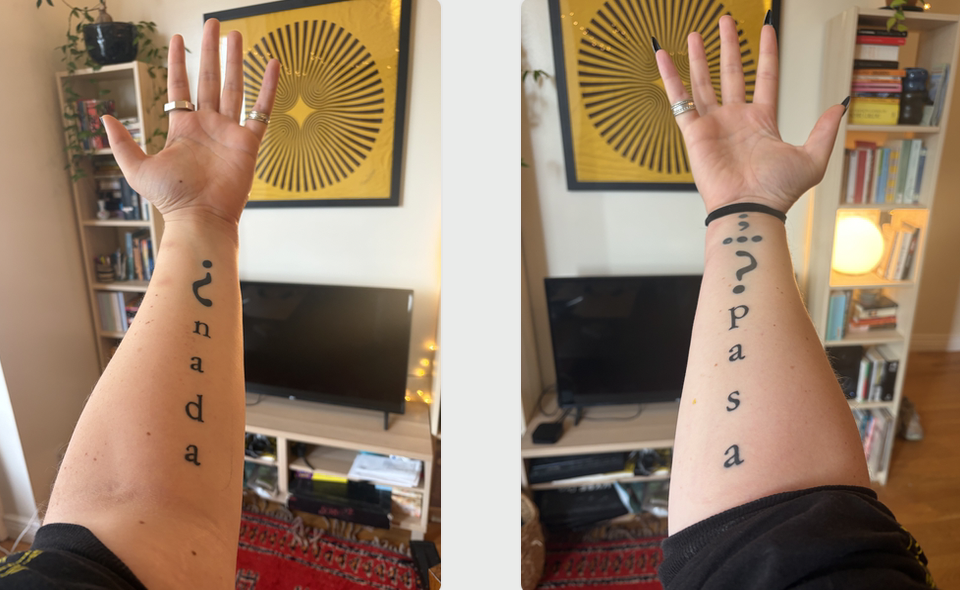
It means “nothing happens.” There is a Spanish expression “no pasa nada,” which could translate to “nothing is happening.” It’s hard to translate perfectly, of course, as is commonly said by “diaspora artists” and literally everyone else, because that’s not how translation works. But this expression is the Spanish “no worries;” it’s the Spanish “it’s alright, man.” I like to have my own words for things, and to me, “nada pasa” is a different sentiment than “nothing is happening.” It translates from Spanish, my second language, into English, my first, literally as “nothing happens.”
The poet W. H. Auden, in his poem “In Memory of W. B. Yeats,” says,
poetry makes nothing happen
I can’t let the poets have all the fun. This, to me, is the point of reading and writing: to learn to make something out of nothing, in other words, to make nothing happen. That’s why I got it tattooed on my arms, and why I got it tattooed to be facing me: as a reminder, because it is something I so often forget. I don’t know whether this is a particularly Audenesque sentiment, or a particularly Yeatsian one, but it is pretty Freedy: it’s kind of what I’m all about, right now, and what I expect to be about for a long time.
This, to me, is also what is politically valuable about reading and writing. When you can make something out of nothing, you can make almost everything. And to to make you feel that, and to begin to make amends with the poets, who I have enjoyed some friendly shit talk with all these years, I leave you with my favorite poem, a poem by a poet who wrote in Punjabi and Urdu, Faiz Ahmad Faiz, entitled “A Prison Evening:”
Each star a rung,
night comes down the spiral
staircase of the evening.
The breeze passes by so very close
as if someone just
happened to speak of love.
In the courtyard,
the trees are absorbed refugees
embroidering maps of return on the sky.
On the roof,
the moon - lovingly, generously -
is turning the stars
into a dust of sheen.
From every corner, dark-green shadows,
in ripples, come towards me.
At any moment they may break over me,
like the waves of pain each time I remember
this separation from my lover.
This thought keeps consoling me:
though tyrants may command that lamps be smashed
in rooms where lovers are destined to meet,
they cannot snuff out the moon, so today,
nor tomorrow, no tyranny will succeed,
no poison of torture make me bitter,
if just one evening in prison
can be so strangely sweet,
if just one moment anywhere on this earth.
Love,